

Hey there, fellow shooting enthusiasts! As a supplier of steel plate chest targets, I've been in the thick of the shooting world for quite a while. One question that comes up time and time again is, "How to measure the accuracy of shooting at a steel plate chest target?" Well, in this blog, I'm gonna break it down for you in a way that's easy to understand.
First off, let's talk about why measuring accuracy is so important. When you're shooting at a steel plate chest target, whether it's for practice, competition, or just some fun at the range, knowing how accurate you are helps you gauge your skills. It allows you to identify areas where you need improvement and track your progress over time. Plus, it's just plain satisfying to see how well you're doing!
One of the most basic ways to measure accuracy is by looking at the hit rate. This is simply the number of times you hit the target divided by the total number of shots fired. For example, if you take 10 shots and hit the target 7 times, your hit rate is 70%. It's a straightforward metric that gives you a quick idea of how well you're connecting with the target.
But hit rate alone doesn't tell the whole story. You could have a high hit rate, but maybe all your hits are clustered around the edges of the target. That's where measuring the dispersion of your shots comes in. Dispersion refers to how spread out your hits are on the target. A tight cluster of hits indicates better accuracy than a wide - spread pattern.
To measure dispersion, you can use a simple method. After you've finished shooting at the steel plate chest target, mark the center of each hit. Then, measure the distance between the outermost hits. You can use a ruler or a caliper for this. The smaller this distance, the better your dispersion and, generally, the higher your accuracy.
Another way to think about dispersion is in terms of the group size. The group size is the diameter of the smallest circle that can enclose all of your hits. A smaller group size means your shots are more tightly grouped, which is a sign of good accuracy.
Now, let's talk about the importance of the target itself. As a steel plate chest target supplier, I know that the quality of the target can affect your accuracy measurements. A well - made target, like the ones we offer at our store, provides a clear and consistent surface for shooting. You can check out our Half Body Steel Plate Target and Steel Plate Target on our website. These targets are designed to give you a true representation of your shooting skills.
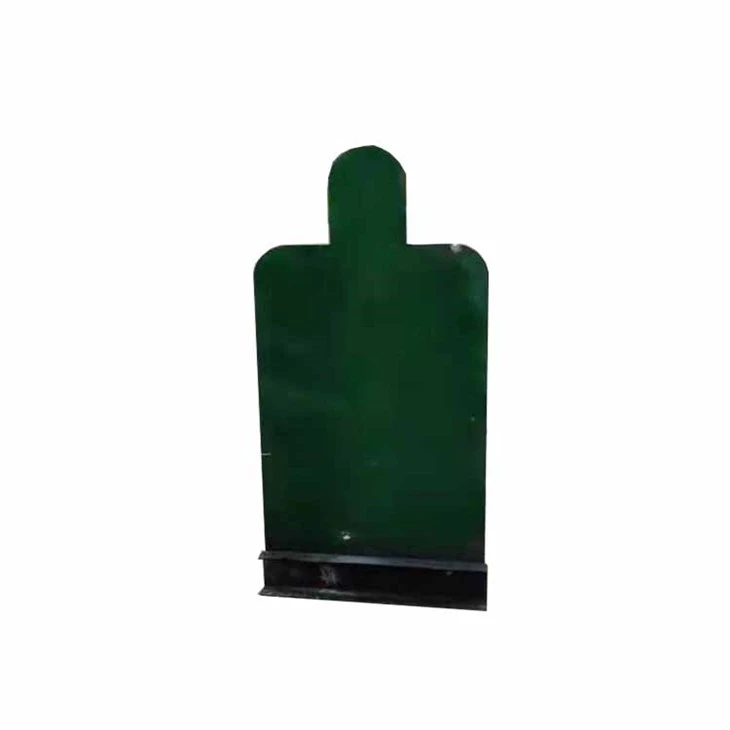
The size and shape of the target also matter. A steel plate chest target is designed to mimic the size and shape of a human torso. This makes it a great training tool for real - world shooting scenarios. But when measuring accuracy, you need to take into account the specific dimensions of the target. For example, if you're aiming for a particular area of the target, like the center mass, you can measure how close your hits are to that area.
When you're shooting at a steel plate chest target, it's also important to consider the distance. The farther you are from the target, the more difficult it is to be accurate. So, when you're comparing your accuracy over different shooting sessions, make sure you're shooting from the same distance each time. You can also set up a series of targets at different distances to test your long - range and short - range accuracy.
Lighting conditions can also have an impact on your accuracy. Poor lighting can make it harder to see the target clearly, which can lead to less accurate shooting. Try to shoot in consistent lighting conditions whenever possible. This will give you more reliable accuracy measurements.
Wind is another factor to keep in mind. Even a gentle breeze can push your bullet off course, especially at longer distances. If you're shooting outdoors, pay attention to the wind direction and speed. You can use a wind meter to get accurate readings. By adjusting your aim based on the wind conditions, you can improve your accuracy.

Now, let's get a bit more technical. You can use ballistic calculators to measure and predict your accuracy. These calculators take into account factors like bullet weight, muzzle velocity, and distance to the target. They can help you determine where your bullet should theoretically land on the target. By comparing the predicted landing point with the actual hit location, you can get a more detailed understanding of your accuracy.
Video recording can also be a valuable tool. Set up a camera to record your shooting sessions. You can then review the footage and analyze your technique. Look for things like your stance, grip, and trigger pull. By making small adjustments to your technique, you can improve your accuracy over time.
In addition to these measurement methods, it's also important to practice regularly. The more you shoot at the steel plate chest target, the better you'll get at controlling your shots and improving your accuracy. Set aside some time at the range each week for practice. Make it a goal to improve your hit rate, reduce your dispersion, and shrink your group size.
As a steel plate chest target supplier, I'm always here to help you get the most out of your shooting experience. Whether you're a beginner or a seasoned pro, our high - quality targets are designed to meet your needs. If you're interested in purchasing a steel plate chest target or have any questions about measuring accuracy, don't hesitate to reach out to us. We can have a great chat about your shooting goals and how our products can help you achieve them.
In conclusion, measuring the accuracy of shooting at a steel plate chest target involves a combination of factors. By considering hit rate, dispersion, group size, and taking into account variables like target quality, distance, lighting, wind, and using tools like ballistic calculators and video recording, you can get a comprehensive understanding of your shooting skills. And remember, regular practice is the key to improving your accuracy. So, head to the range, start shooting, and see how much you can improve. If you're ready to take your shooting to the next level, check out our Steel Plate Target and Half Body Steel Plate Target. And if you're interested in purchasing, feel free to contact us for a friendly chat about your requirements.
References
Rinker, Robert A. "Understanding Firearm Accuracy." Gun Digest, 2010.
Hodgdon Powder Company. "Ballistics Basics." Hodgdon's reloading manuals, various editions.


