

As a supplier of Shock Wave Lifting Targets, I am often asked about the scientific basis behind this innovative product. In this blog post, I will delve into the technical details and explain the principles that make Shock Wave Lifting Targets a reliable and effective solution for shooting ranges.
The Physics of Shock Waves
To understand the scientific basis of Shock Wave Lifting Targets, we first need to grasp the concept of shock waves. A shock wave is a type of propagating disturbance that moves faster than the local speed of sound in the medium. When a bullet travels through the air, it creates a pressure wave that can be classified as a shock wave under certain conditions. The shock wave is characterized by a sudden and significant increase in pressure, density, and temperature as it passes through a point in space.
The generation of shock waves by a bullet is a complex process that involves the interaction between the bullet's high - velocity motion and the air molecules. As the bullet moves through the air, it compresses the air in front of it, creating a region of high pressure. This high - pressure region propagates outward as a shock wave. The intensity of the shock wave depends on several factors, including the bullet's velocity, its mass, and the shape of the bullet.
How Shock Waves Interact with Targets
The Shock Wave Lifting Target [/military-and-police-shooting-smart-range/shock-wave-lifting-target.html] is designed to respond to these shock waves. When a shock wave reaches the target, it exerts a force on the surface of the target. The magnitude of this force is related to the pressure differential across the shock wave and the area of the target that is exposed to the shock wave.
According to Newton's second law of motion, F = ma (force equals mass times acceleration). When the force exerted by the shock wave on the target is large enough, it can overcome the target's inertia and cause it to move. In the case of a Shock Wave Lifting Target, the target is designed in such a way that the shock wave from a passing bullet can lift the target, indicating a hit.

The design of the target is crucial to its performance. The target needs to have a proper balance between its mass and the surface area exposed to the shock wave. If the target is too heavy, the shock wave may not be able to generate enough force to lift it. On the other hand, if the target is too light, it may be easily influenced by environmental factors such as wind, leading to false alarms.
Material Selection and Design Considerations
The materials used in the construction of Shock Wave Lifting Targets also play a significant role in their effectiveness. The target material should be able to withstand the repeated impact of shock waves without significant damage or deformation. Many shock wave lifting targets are made of high - strength plastics or composite materials. These materials have good mechanical properties, such as high stiffness and toughness, which allow them to maintain their shape and function over time.
In addition, the shape of the target is optimized to enhance its sensitivity to shock waves. For example, a target with a larger surface area perpendicular to the direction of the bullet's flight path will be more likely to catch the shock wave and respond to it. Some shock wave lifting targets have a concave or convex shape, which can help to focus the shock wave and increase the force exerted on the target.
Integration with Smart Shooting Range Management Systems
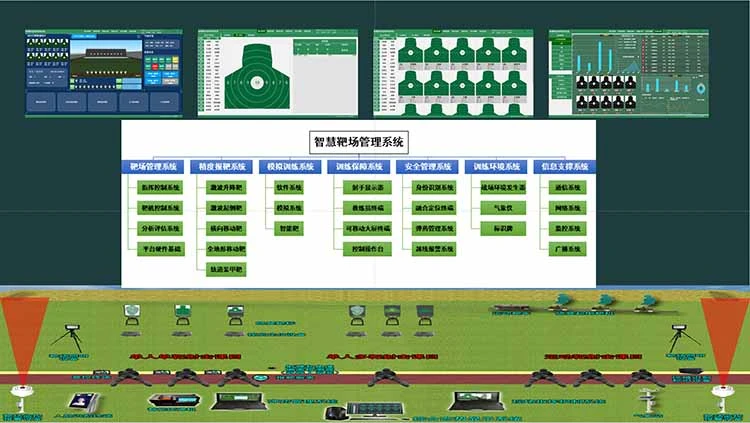
Shock Wave Lifting Targets can be effectively integrated with Smart Shooting Range Management System. These systems can monitor the state of the targets in real - time. When a target is lifted by a shock wave, the system can record the event, including the time of the hit, the location of the target, and other relevant data.
The smart shooting range management system uses sensors and software algorithms to analyze the data collected from the targets. This data can be used for training evaluation, safety management, and performance improvement. For example, trainers can use the data to identify areas where trainees need more practice, and range managers can use it to ensure the proper functioning of the shooting range.
Comparison with Other Target Systems
Compared with traditional target systems, such as mechanical or electronic targets, Shock Wave Lifting Targets offer several advantages. First, they are more responsive to bullet impacts. Since they rely on shock waves, they can detect a hit even if the bullet does not directly strike the target. This makes them suitable for training scenarios where accuracy is crucial.
Second, Shock Wave Lifting Targets are relatively simple in design and operation. They do not require complex wiring or external power sources, which reduces the cost of installation and maintenance. In contrast, electronic targets often require a power supply and extensive wiring, which can be prone to failure and require more technical expertise to repair.
However, they also have some limitations. For example, their performance can be affected by environmental factors such as wind and humidity. High - speed winds can disrupt the shock wave propagation, making it more difficult for the target to detect a hit accurately. In addition, extreme humidity can affect the material properties of the target, potentially reducing its sensitivity.
Applications of Shock Wave Lifting Targets
Shock Wave Lifting Targets have a wide range of applications in military and police training. In military training, these targets can be used to simulate real - combat scenarios, where soldiers need to quickly and accurately identify and engage targets. The ability of the targets to respond to shock waves allows for more realistic training experiences, as soldiers can practice shooting at targets without having to physically hit them every time.
In police training, Shock Wave Lifting Targets can be used to improve officers' shooting skills and decision - making abilities. The targets can be set up in different configurations to simulate various law - enforcement situations, such as hostage - rescue operations or active - shooter scenarios. The real - time feedback provided by the targets and the integrated smart shooting range management system can help officers to evaluate their performance and make necessary improvements.
Conclusion and Call to Action
In conclusion, the scientific basis of Shock Wave Lifting Targets lies in the physics of shock waves and their interaction with the target materials. Through careful design, material selection, and integration with smart shooting range management systems, these targets offer a reliable and effective solution for shooting range applications.
If you are interested in enhancing your shooting range with high - quality Shock Wave Lifting Targets, we invite you to contact us for procurement discussions. Our team of experts is ready to provide you with detailed information about our products, including their features, performance, and pricing. We are committed to helping you find the best shooting range solutions that meet your specific needs.
References
- Anderson, J. D. (2001). Fundamentals of Aerodynamics. McGraw - Hill.
- Halliday, D., Resnick, R., & Walker, J. (2013). Fundamentals of Physics. Wiley.


