

What are the kinematic equations for 90 degree up and down movement?
When it comes to 90 - degree up and down movement, also known as vertical motion in a straight - line, kinematic equations play a crucial role in understanding and predicting the behavior of objects. As a supplier specializing in products that involve 90 - degree up and down movement, such as the Multifunctional Tactical Starting and Falling Target, 24V Lifting Target, and Tracked Motion Target, having a solid grasp of these equations is essential for product design, performance optimization, and customer satisfaction.
Basic Concepts of Vertical Motion
In vertical motion, the key factors we need to consider are displacement ((y)), initial velocity ((v_{0y})), final velocity ((v_y)), acceleration ((a)), and time ((t)). The most common acceleration in vertical motion near the surface of the Earth is the acceleration due to gravity, denoted as (g), which has a value of approximately (g = 9.8\ m/s^{2}) downward.
The Kinematic Equations
- Equation 1: (v_y=v_{0y}+at)
This equation relates the final velocity ((v_y)), initial velocity ((v_{0y})), acceleration ((a)), and time ((t)). In the case of vertical motion, if we take the upward direction as positive, the acceleration (a=-g) (negative because gravity acts downward). For example, if we launch a target upward with an initial velocity (v_{0y}), after a certain time (t), the velocity of the target at that moment can be calculated using this equation. When the target reaches its maximum height, its final velocity (v_y = 0). We can use this equation to find the time it takes for the target to reach the maximum height. Rearranging the equation for (t) gives (t=\frac{v_y - v_{0y}}{a}=\frac{0 - v_{0y}}{-g}=\frac{v_{0y}}{g}). - Equation 2: (y = v_{0y}t+\frac{1}{2}at^{2})
This equation gives the displacement ((y)) of an object in terms of the initial velocity ((v_{0y})), time ((t)), and acceleration ((a)). Again, for vertical motion with (a=-g), if we know the initial velocity of a target launched upward and the time elapsed, we can calculate how high the target has traveled. For instance, if a 24V Lifting Target is lifted with an initial upward velocity (v_{0y}), the height (y) it reaches after time (t) is given by (y = v_{0y}t-\frac{1}{2}gt^{2}). - Equation 3: (v_y^{2}=v_{0y}^{2}+2ay)
This equation relates the initial velocity ((v_{0y})), final velocity ((v_y)), acceleration ((a)), and displacement ((y)). It is useful when we want to find the final velocity of an object without knowing the time. For example, if we know the initial velocity of a target launched upward and the height it reaches ((y)), we can find the velocity of the target at that height. At the maximum height, (y = h_{max}) and (v_y = 0). Rearranging the equation to find the maximum height gives (h_{max}=\frac{v_{0y}^{2}}{2g}). - Equation 4: (y=\frac{v_{0y} + v_y}{2}t)
This equation is derived from the fact that the average velocity (\bar{v}=\frac{v_{0y}+v_y}{2}) and displacement (y=\bar{v}t). It is useful when we know the initial and final velocities and the time of motion.
Applications in Our Products
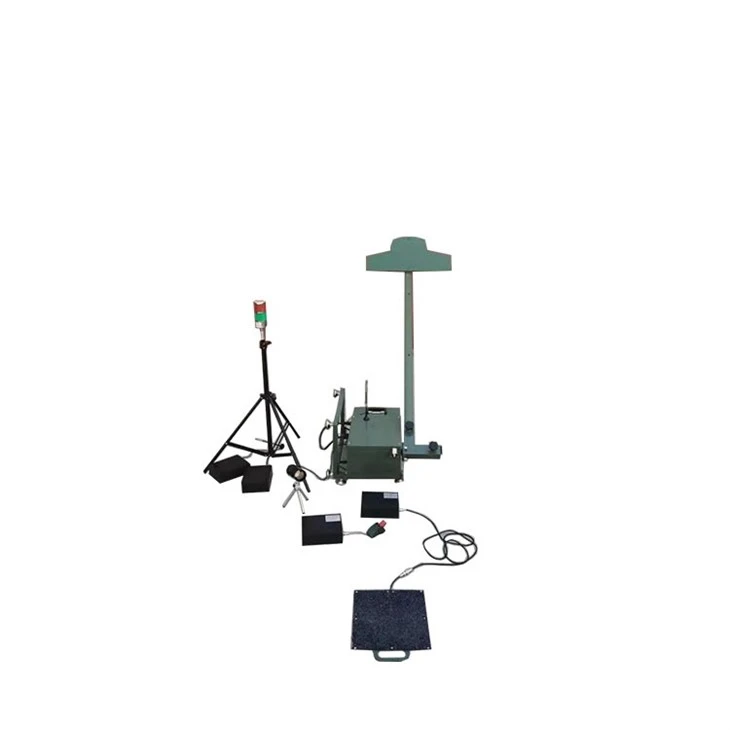
Our Multifunctional Tactical Starting and Falling Target involves both upward and downward 90 - degree motion. When the target is launched upward, we can use the kinematic equations to ensure that it reaches the desired height within a specific time. The initial velocity of the launch can be adjusted based on the equations to achieve the required performance. For example, if we want the target to reach a height of (h) in time (t), we can first use the equation (y = v_{0y}t+\frac{1}{2}at^{2}) and substitute (y = h) and (a=-g) to solve for the initial velocity (v_{0y}).
The 24V Lifting Target also operates based on vertical motion principles. The motor in the target provides an initial upward force, which results in an initial velocity. By understanding the kinematic equations, we can design the motor's power and control system to ensure smooth and accurate lifting and lowering of the target.
The Tracked Motion Target may have components that move vertically. For example, some parts of the target may need to rise and fall at specific intervals. The kinematic equations help us determine the speed, height, and timing of these vertical movements, ensuring that the target behaves as expected during live - fire shooting exercises.
Analyzing the Motion of Our Products
Let's take a more in - depth look at how we can analyze the motion of our products using the kinematic equations. Suppose we have a Multifunctional Tactical Starting and Falling Target that is launched upward with an initial velocity (v_{0y}=15\ m/s).

- Time to Reach Maximum Height: Using the equation (v_y = v_{0y}+at) with (v_y = 0) and (a=-g=- 9.8\ m/s^{2}), we can find the time (t) it takes for the target to reach the maximum height. (t=\frac{v_y - v_{0y}}{a}=\frac{0 - 15}{-9.8}\approx1.53\ s).
- Maximum Height: Using the equation (v_y^{2}=v_{0y}^{2}+2ay) with (v_y = 0), (a=-g), and (v_{0y}=15\ m/s), we can find the maximum height (y). Rearranging the equation gives (y=\frac{v_y^{2}-v_{0y}^{2}}{2a}=\frac{0 - 15^{2}}{2\times(-9.8)}\approx11.48\ m).
- Time of Flight: The time of flight is the total time the target is in the air. When the target returns to the same level from which it was launched, the displacement (y = 0). Using the equation (y = v_{0y}t+\frac{1}{2}at^{2}) with (y = 0) and (a=-g), we get (0 = v_{0y}t-\frac{1}{2}gt^{2}). Factoring out (t) gives (t(v_{0y}-\frac{1}{2}gt)=0). One solution is (t = 0) (corresponds to the initial time). The other solution is (t=\frac{2v_{0y}}{g}). Substituting (v_{0y}=15\ m/s) and (g = 9.8\ m/s^{2}), we get (t=\frac{2\times15}{9.8}\approx3.06\ s).
Importance of Kinematic Equations in Product Design and Quality Control
Understanding the kinematic equations is crucial for product design. We can use these equations to optimize the performance of our targets. For example, we can adjust the initial velocity and acceleration of the targets to ensure that they meet the requirements of different shooting scenarios. In quality control, we can measure the actual motion of the targets and compare it with the predicted motion based on the kinematic equations. If there are significant differences, it may indicate a problem with the product, such as a faulty motor or mechanical issue.
Conclusion
In conclusion, the kinematic equations for 90 - degree up and down movement are essential tools for us as a supplier of products that involve vertical motion. These equations allow us to design, analyze, and optimize the performance of our Multifunctional Tactical Starting and Falling Target, 24V Lifting Target, and Tracked Motion Target. By having a deep understanding of these equations, we can provide high - quality products that meet the needs of our customers in live - fire shooting venues.
If you are interested in our products and would like to discuss your specific requirements, we invite you to contact us for a procurement negotiation. Our team of experts is ready to assist you in finding the best solutions for your shooting training needs.
References
- Halliday, D., Resnick, R., & Walker, J. (2014). Fundamentals of Physics. Wiley.
- Serway, R. A., & Jewett, J. W. (2018). Physics for Scientists and Engineers with Modern Physics. Cengage Learning.


